
Understanding the Three-Coat Stucco System
How Traditional Stucco Walls Are Built—and the Finishes Homeowners See
Stucco is one of the most recognizable exterior finishes in California, particularly throughout Santa Barbara and the Central Coast, where it plays an important role in Spanish Colonial Revival, Mediterranean, and other regional architectural styles.
But there is much more behind a stucco exterior than the texture and color you see from the street.
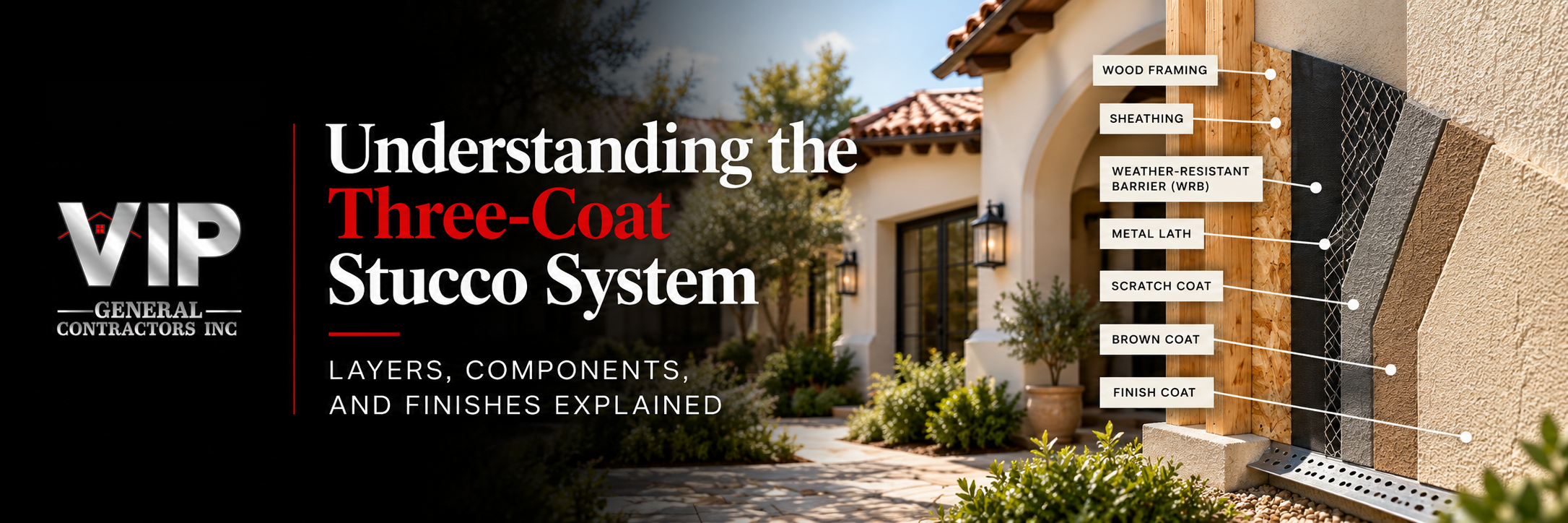
Traditional three-coat stucco is an exterior wall system made up of three cement-based coats: the scratch coat, brown coat, and finish coat. On wood-framed construction, those coats are installed as part of a larger wall assembly that typically includes sheathing, a weather-resistant barrier (WRB), metal lath, flashing, and a weep screed.
Each component serves a different purpose. Together, they help reinforce the stucco, manage moisture, and create the finished exterior appearance of the home.
What Are the Three Coats of Traditional Stucco?
The three stucco coats are applied in sequence, with each layer serving a different purpose.
1. Scratch Coat
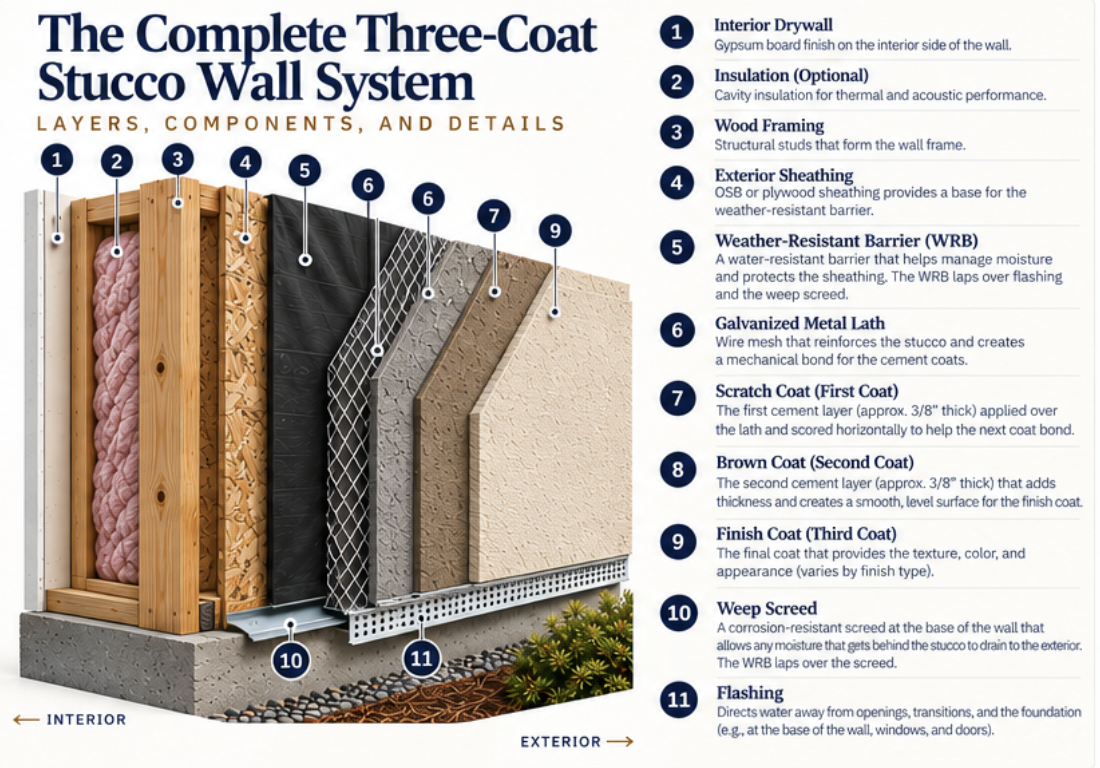
The scratch coat is the first cement-based layer applied over the metal lath. While the material is still workable, horizontal grooves are scored—or “scratched”—into the surface. These grooves help create a mechanical bond for the brown coat that follows.
2. Brown Coat
The brown coat is the second cement-based layer. It builds thickness and creates a flatter, more uniform surface in preparation for the final finish.
3. Finish Coat
The finish coat is the third and final layer—and the one homeowners actually see. This coat provides the stucco's finished color, texture, and architectural appearance.
What Is Behind the Stucco?
The long-term performance of a stucco exterior depends on more than the three cement coats. Several components behind and around the stucco work together as part of the home's exterior wall and moisture-management system.
Weather-Resistant Barrier (WRB)
The weather-resistant barrier, or WRB, is installed behind the stucco system to help prevent water that reaches the drainage plane from entering the building.
Stucco itself isn't intended to be the wall's only defense against moisture. The WRB works together with flashing and drainage components to direct water toward the exterior.
Metal Lath
On traditional framed construction, galvanized metal lath provides reinforcement and mechanical attachment for the stucco. The first cement coat works through and around the lath, helping mechanically key the materials together.
Weep Screed
A weep screed is installed along the bottom of the stucco wall assembly. Its openings provide a path for incidental moisture behind the stucco to drain toward the exterior while also establishing the lower termination of the stucco system.
Flashing
Flashing is used around vulnerable areas such as windows, doors, penetrations, and transitions to help direct water away from the building. The flashing, WRB, and drainage components need to work together as part of the overall exterior wall system.
WHY THIS MATTERS: A beautiful finish coat is only the visible part of the system. Proper attention to the components and details behind the stucco is equally important to the wall's long-term performance.
How Is Three-Coat Stucco Installed?
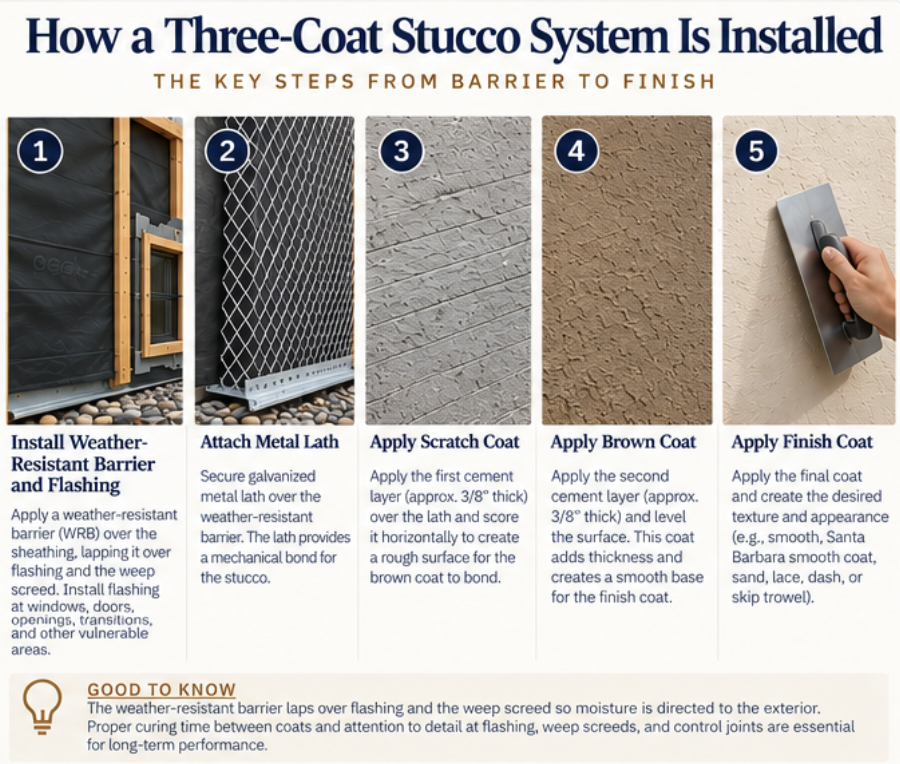
Specific assemblies and requirements can vary by project, but traditional three-coat stucco on framed residential construction generally follows five basic stages.
Step 1 — Install the WRB & Flashing
The weather-resistant barrier is installed over the exterior sheathing, with flashing integrated around windows, doors, penetrations, transitions, and other required areas. The weep screed is incorporated at the base of the wall.
Step 2 — Attach the Metal Lath
Metal lath is installed over the prepared wall assembly and properly fastened to provide reinforcement and mechanical attachment for the stucco.
Step 3 — Apply the Scratch Coat
The first cement coat is applied over the lath and horizontally scratched to prepare the surface for the next layer.
Step 4 — Apply the Brown Coat
The second cement coat builds the stucco assembly to the required thickness and creates an even surface for the finish material.
Step 5 — Apply the Finish Coat
The final coat creates the visible color and texture of the completed wall.
How Thick Is Three-Coat Stucco?
Traditional three-coat cement plaster over metal lath is commonly installed with a 7/8-inch nominal thickness for the base coats, although the exact assembly and finish depend on the specified system and applicable requirements.
Thickness isn't the only factor that matters. Material selection, substrate preparation, fastening, flashing, drainage details, curing, and workmanship all contribute to the performance of the completed wall.
What Are the Most Common Stucco Finishes?
While the three-coat system determines how the wall is constructed, the finish coat determines how it looks.
Different materials, aggregates, tools, and application techniques can create dramatically different appearances.
Smooth Finish
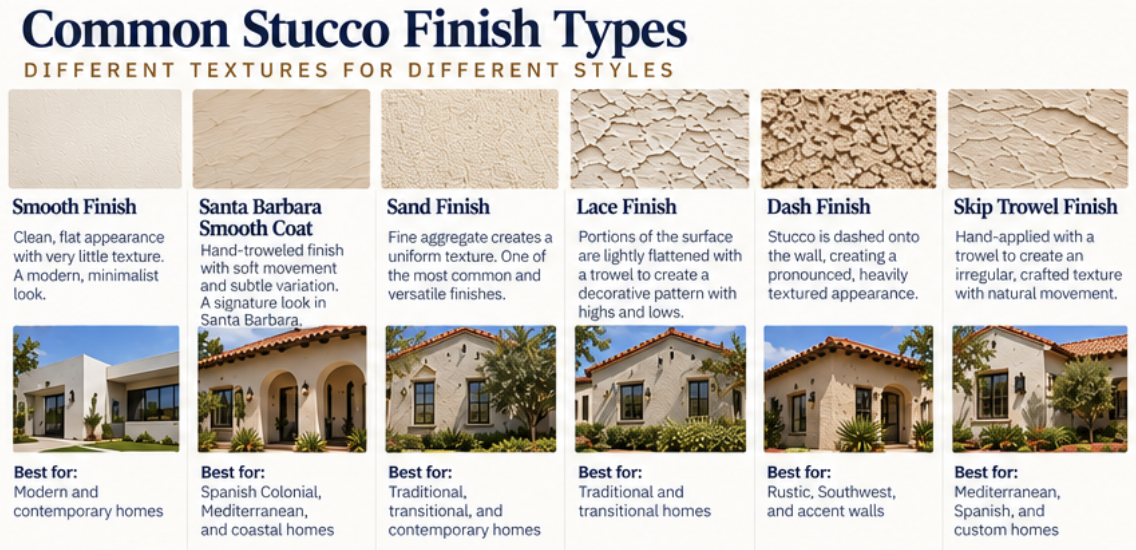
Smooth stucco has very little visible texture, creating a clean and refined appearance that works particularly well with modern and contemporary architecture.
Because there is less texture to disguise variations in the surface, imperfections can be more noticeable.
Santa Barbara Smooth Coat
This one deserves special attention for VIP's Central Coast homeowners. Santa Barbara Smooth Coat has a softer, handcrafted appearance. Instead of creating a perfectly uniform surface, subtle trowel movement and variation remain visible.
The result is the understated Old World character associated with many Spanish Colonial Revival and Mediterranean homes throughout Santa Barbara and the Central Coast.
Sand Finish
A sand finish uses fine aggregate to create a consistent granular texture. Different aggregate sizes can produce anything from a relatively fine appearance to a more pronounced texture.
Lace Finish
Lace creates areas of raised and flattened texture across the wall, producing more visual variation than smooth or sand finishes.
Dash Finish
Dash finish is created by projecting the finish material onto the wall, resulting in a pronounced texture that can range from moderate to coarse.
Skip Trowel Finish
Skip trowel is hand-applied to create intentionally irregular texture and movement. Its handcrafted character works particularly well with Mediterranean, Spanish, and other traditional architectural styles.
How Do Stucco Finishes Compare?
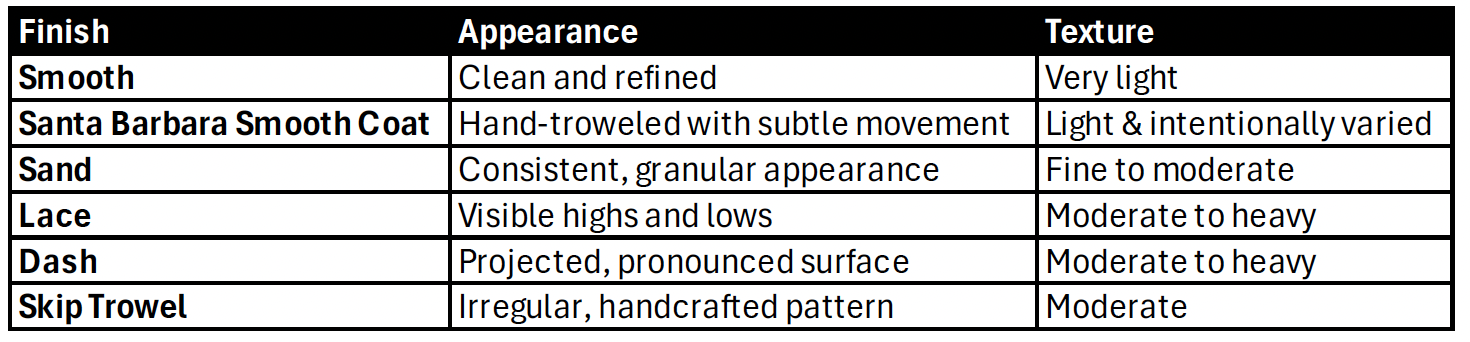
The right finish ultimately depends on the architecture of the home, the desired aesthetic, and the character you want the exterior to have.
Common Questions About Stucco
Is stucco waterproof?
Stucco shouldn't be thought of as a waterproof wall covering. Cement plaster can absorb moisture, which is why the complete wall assembly incorporates WRBs, flashing, drainage provisions, sealants where appropriate, and other construction details designed to manage water.
Does stucco crack?
Small cracks can occur because cement-based stucco is rigid while buildings experience drying shrinkage, temperature changes, structural movement, and other stresses. Not every crack means the same thing. Its width, pattern, location, recurrence, and the presence of moisture can all help determine whether additional evaluation may be appropriate.
Can stucco be painted?
Yes. Many existing stucco homes have painted finishes. Other systems use integral color, where pigment is incorporated directly into the finish material. Painted and integral-color finishes have different appearances and maintenance considerations.
Can three-coat stucco be repaired?
Often, yes—but the appropriate repair depends on the source and depth of the damage. A surface issue may involve only the finish, while deeper cracking or water intrusion may require investigation of the underlying coats, lath, WRB, flashing, or substrate. Matching an existing color and texture can also be challenging, particularly with aged or hand-troweled finishes.
Questions to Ask Before a Stucco Project
If you're discussing new stucco installation or a major exterior renovation, consider asking:
What stucco system is specified?
What WRB assembly will be used?
How will window and door flashing integrate with the WRB?
Where will the stucco terminate and drain?
What finish texture is specified?
Will the finish use integral color or be painted?
How will transitions and penetrations be detailed?
What curing requirements apply to the selected system?
These questions aren't about choosing one particular product or construction method. They're intended to help homeowners better understand how the different components of the exterior wall will work together.
Understanding the Complete Stucco System
Traditional three-coat stucco is much more than the exterior texture visible on a home.
The scratch, brown, and finish coats create the three-coat stucco system, while components such as the WRB, metal lath, flashing, and weep screed contribute to the performance of the complete wall assembly.
For California homeowners—and particularly those throughout Santa Barbara and the Central Coast—understanding both how stucco is constructed and how the finish affects the home's appearance can make it easier to have informed conversations when planning a new build, addition, or major exterior renovation.
Planning a New Build or Exterior Renovation?
VIP General Contractors Inc. works with homeowners throughout Southern California to plan and build thoughtfully designed residential projects from the ground up.
Whether you're planning a custom home, home addition, or whole home renovation, our team can help coordinate the design, materials, construction details, and finishes that bring the entire project together.
Contact VIP General Contractors Inc to schedule a consultation and start planning your project.